Why No One Can Visit North Sentinel Island – and What Happens When They Try
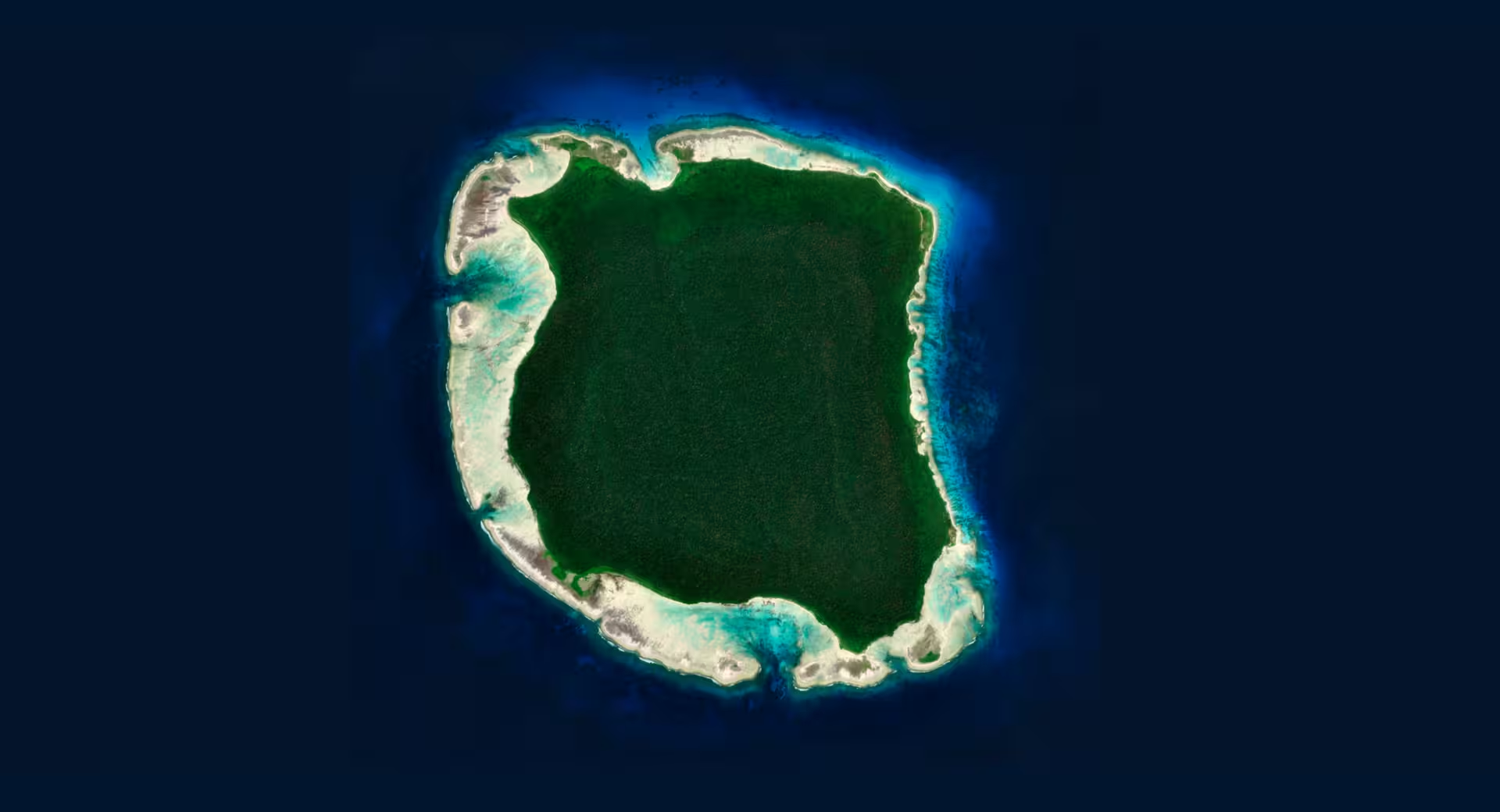
In the Bay of Bengal, about 50 kilometers west of the Andaman Islands, there is a small forested island roughly the size of Manhattan. You cannot visit it. You cannot approach within 5 nautical miles of its shore. If you try, you risk arrest by the Indian government — and, if you get close enough, an arrow from the people who live there.
North Sentinel Island is one of the most forbidden places on Earth, and it is forbidden for reasons that have nothing to do with military secrets, toxic waste, or political instability. It is forbidden because of the people who chose to stay — and because of what history has taught us happens when outsiders don’t take that choice seriously.
Who are the Sentinelese?
The Sentinelese are among the most isolated human communities on the planet. Genetic and archaeological evidence suggests their ancestors may have settled on North Sentinel Island up to 60,000 years ago — making them descendants of some of the earliest human migrations out of Africa. They are hunter-gatherers: they fish the coastal waters, hunt in the forest, and have shown no interest in agriculture, metal tools, or contact with the outside world.
No one knows exactly how many Sentinelese there are. Estimates range from as few as 35 to as many as 500 individuals, with most researchers settling on a figure between 50 and 150. No one knows what language they speak, what they call themselves, or what they call their island. Every sustained attempt to establish communication has either been rejected or ended in violence.
What is clear is that they are aware of the outside world. They have seen ships and helicopters. They have encountered outsiders — and they have, consistently across centuries, chosen to drive them away.
A history of disastrous contact
The Sentinelese did not always reject contact violently. Or rather: their hostility makes considerably more sense when you understand what contact has historically meant for isolated peoples.
In 1880, British colonial administrator Maurice Vidal Portman led an expedition to North Sentinel Island as part of what he framed as a “civilizing” mission. His team swept through the jungle, the islanders fled into the forest, and eventually his men captured an elderly man and woman and four children — abducting them to Port Blair, the colonial capital, for what Portman described as scientific observation. The adults fell ill almost immediately and died. The children were returned to the island carrying gifts — and, almost certainly, pathogens their immune systems had never encountered.
This pattern — contact, disease, catastrophic death — has repeated itself across history wherever isolated populations have met outsiders for the first time. The Sentinelese have no immunity to common illnesses like influenza, measles, or even the common cold. A single infected visitor could trigger an epidemic capable of destroying the entire community. The island is not an exotic curiosity. For the people who live there, it is a matter of survival.
The Indian government recognized this and in 1956 passed the Andaman and Nicobar Islands Protection of Aboriginal Tribes Regulation, banning unauthorized approach to North Sentinel and several other islands in the archipelago. The law was strengthened over subsequent decades. Today, coming within 5 nautical miles of the island without specific government authorization is a criminal offense, regardless of nationality.
The brief window when contact seemed possible
The history of North Sentinel Island is not only a history of violence and refusal. For a few years in the early 1990s, something unexpected happened.
The Indian government authorized a series of careful, non-invasive contact attempts by teams from the Anthropological Survey of India, who approached by boat and left coconuts, metal tools, and cloth on the beach before retreating. In January 1991, during one of these visits, something changed: the Sentinelese approached without weapons for the first time. They waded into the shallows to collect coconuts from the boat, examined it with curiosity, and allowed some team members to walk briefly on the beach. Madhumala Chattopadhyay, an anthropologist who was part of the team and later became the first woman known to have made peaceful contact with the Sentinelese, described the encounter as genuinely reciprocal — a moment of mutual, cautious observation.
It was the closest the outside world has ever come to a conversation with North Sentinel Island.
The Indian government quietly ended the contact program in 1994. Decades of evidence from similar encounters with uncontacted peoples worldwide had made the consensus among specialists clear: the risk of introducing disease was too high, and the Sentinelese’s preference was not ambiguous. The program was discontinued not because contact had failed, but because — on reflection — it should never have been attempted.
The people who tried anyway
The law has not stopped everyone.
On December 28, 2004, three days after the Indian Ocean tsunami killed over 200,000 people across the region, an Indian Coast Guard helicopter flew low over North Sentinel Island to check whether the island had been inundated. A single Sentinelese man emerged from the forest, walked onto the beach, and fired an arrow at the aircraft. The photograph taken from the helicopter became one of the most recognizable images in recent memory: the island had survived, the people were alive, and they still wanted to be left alone.
The most widely known human attempt came in November 2018. John Allen Chau, a 26-year-old American evangelical missionary, had spent years preparing for what he believed was a divinely mandated mission to bring Christianity to the Sentinelese. He paid local fishermen to bring him close to the island, then made his way to shore by kayak over the course of several days. On his first approach, a young Sentinelese boy fired an arrow that struck a Bible he was carrying. He returned twice more. On November 17, he was killed. His body was never recovered.
The reaction divided along predictable lines. Some mourned a young man of sincere, if catastrophically misguided, conviction. Indigenous rights organizations were blunter. Survival International stated directly: “Sending missionaries to contact uncontacted tribes is incredibly dangerous for the tribes.” India’s response was similarly clear: Chau had broken the law, knowingly placed a vulnerable population at existential risk, and disregarded their expressed wishes.
In late 2024 and early 2025, a 24-year-old American named Mykhailo Viktorovych Polyakov made two separate attempts to reach the island — first by inflatable kayak in October 2024, then again in January 2025. He was detained by Indian authorities before reaching the shore. His motivations were not publicly disclosed.
The question no one can answer
Here is what makes North Sentinel Island genuinely strange, beyond the headlines: we do not actually know what life there looks like.
We have aerial photographs showing cleared areas, structures, and canoes on the beach. We have brief, distant observations from authorized government boats. We have a handful of photographs taken from helicopters and from the sea. Everything else is inference.
The Sentinelese are not primitive — a word that implies an early stage of a journey toward somewhere else. By any reasonable interpretation, they are exactly where they have chosen to be: on an island they know in extraordinary depth, living in a way that has sustained them for tens of thousands of years, declining every invitation to join a world they have observed and, apparently, rejected.
Why the law exists
There is a philosophical dimension to the protection of North Sentinel Island that extends beyond disease prevention.
The Sentinelese have not consented to contact. They have expressed, in the only language available to them, a clear and repeated preference to be left alone. The Indian government’s position — now broadly supported by anthropologists and indigenous rights organizations worldwide — is that this preference deserves to be respected, not overcome.
This is a relatively recent idea in the history of how powerful societies have treated isolated ones. For most of recorded history, isolation was treated as a problem to be solved, a backwardness to be corrected, a people to be converted or studied or absorbed. North Sentinel Island represents, in a quiet way, a different position: that some choices belong only to the people who make them — and that the most ethical thing the outside world can do is stay outside.
The island sits there, 50 kilometers from everything, forested and quiet. Whatever is happening inside it is not for us to see.
North Sentinel Island falls under the jurisdiction of the Andaman and Nicobar Islands administration, India. Unauthorized approach is a criminal offense under the Andaman and Nicobar Islands (Protection of Aboriginal Tribes) Regulation, 1956, and subsequent amendments.
Sources : National Geographic — North Sentinel Island · Survival International — Sentinelese · Wikipedia — Maurice Vidal Portman · Wikipedia — Madhumala Chattopadhyay · Wikipedia — John Allen Chau · Britannica — North Sentinel Island · Newsweek — Polyakov 2025 · The Wire — history of contact
Cover photo credit : Contains modified Copernicus Sentinel data 2023