
Göbekli Tepe: Why Was the World’s Most Remarkable Ancient Temple Deliberately Buried?
Twelve thousand years ago, someone built a temple on a hilltop in what is now southeastern Turkey. Then, around 8000 BCE, they buried it.
Not a landslide. Not neglect. Someone filled the enclosures of Göbekli Tepe — widely regarded as the oldest temple in the world — pillar by pillar, with rubble and debris, deliberately. Göbekli Tepe lay hidden for ten millennia until German archaeologist Klaus Schmidt began excavating it in 1994 and realized he had found something that would upend everything we thought we knew about human prehistory.
Why was Göbekli Tepe deliberately buried? That question is one of the most fascinating unsolved problems in archaeology — and answering it requires first understanding what makes this place so extraordinary.
What is Göbekli Tepe?
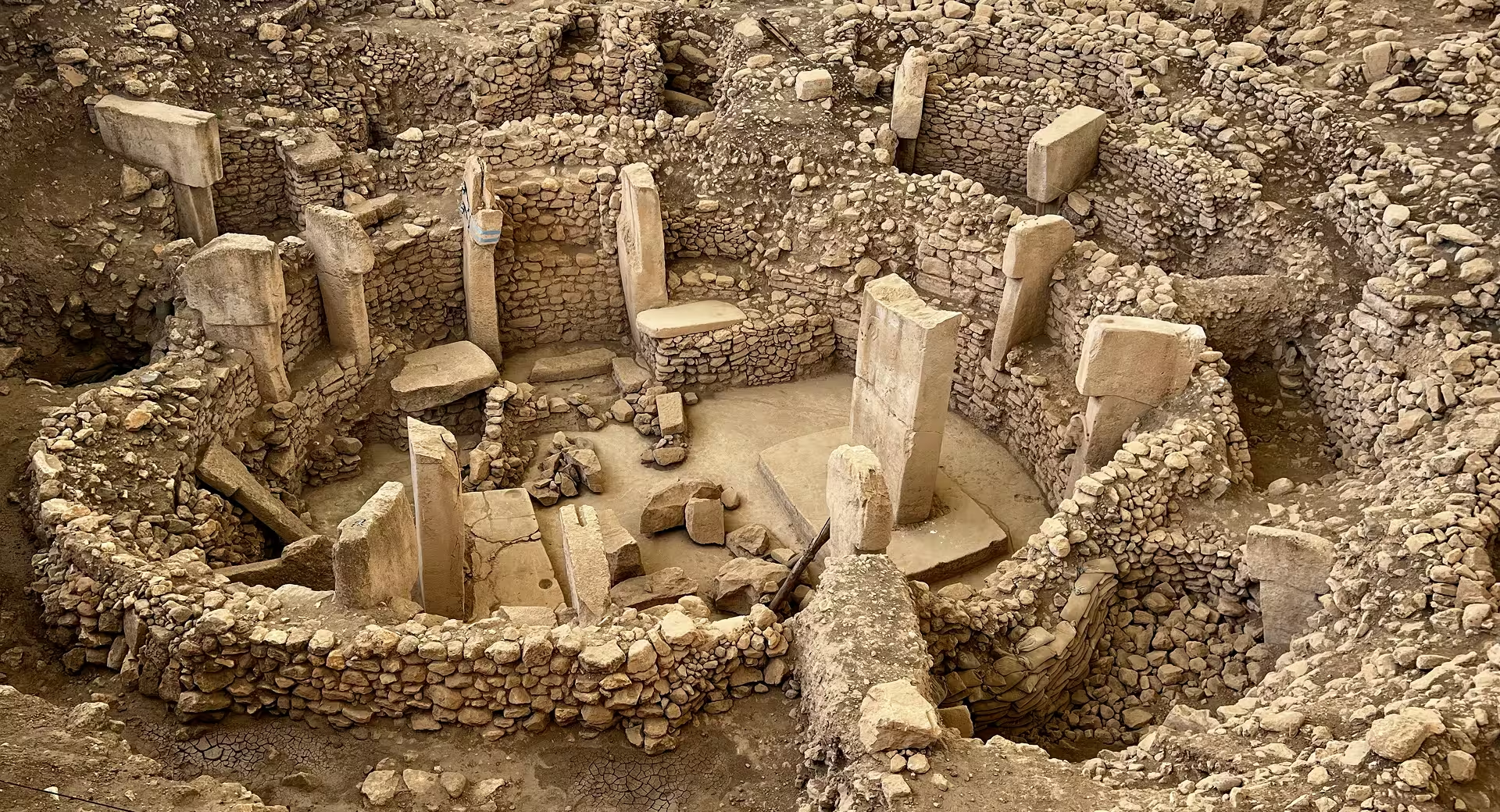
Located near the city of Şanlıurfa in southern Turkey, Göbekli Tepe — roughly “Potbelly Hill” in Turkish — is the oldest known example of monumental architecture on Earth. Its oldest structures date to around 9600–9000 BCE: more than 6,000 years before Stonehenge, and seven millennia before the Egyptian pyramids.
The site consists of a series of circular enclosures, each formed by T-shaped limestone pillars rising up to five meters high. More than 200 pillars have been identified so far. They are not blank: carved in high relief, they depict foxes, snakes, vultures, boars, wild ducks, and abstract symbols whose meaning remains unknown. Several pillars appear to represent stylized human figures — arms carved along their sides, belts around their waist — suggesting that whatever was worshipped here may have had a human face.
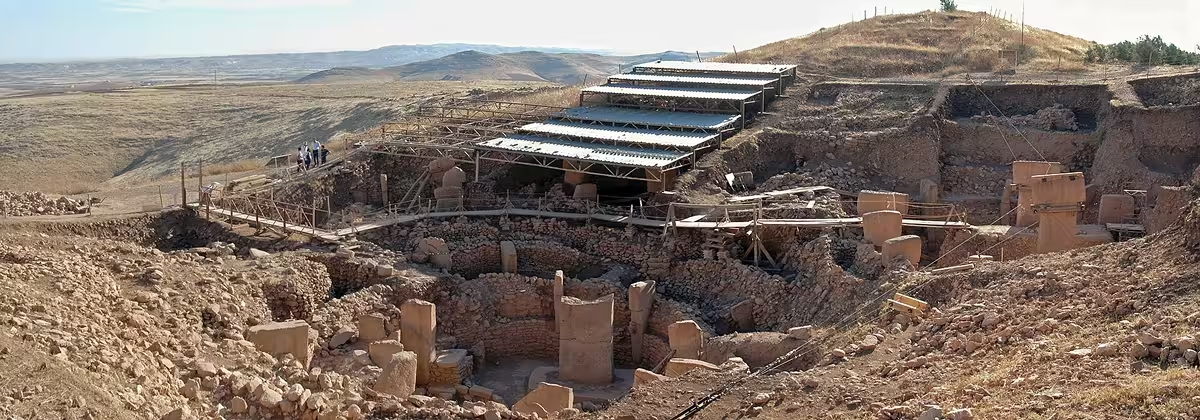
Here is the detail that makes Göbekli Tepe genuinely vertiginous: archaeologists estimate that less than ten percent of the site has been excavated. What we know is the surface of what is there.
The problem with the old story
For much of the twentieth century, the standard account of human history went something like this: hunter-gatherers were too busy surviving to build. Permanent settlement and agriculture came first — only then did people have the surplus time and social organization needed for monumental construction.
Göbekli Tepe dismantles this sequence entirely.
The people who built it were hunter-gatherers. There is no evidence of agriculture, of permanent settlement, or of the complex hierarchies we usually associate with large building projects. Yet they quarried limestone blocks weighing up to twenty tons, transported them uphill, and erected them with a precision that has survived twelve millennia.
As Schmidt himself put it before his death in 2014: “First came the temple, then the city.”
Some researchers have since gone further, suggesting that Göbekli Tepe may have inverted the standard model of civilization — that the need to gather regularly for collective ritual may have been what drove communities toward agriculture in the first place, rather than the other way around.
Pillar 43: the stone that started a thousand theories
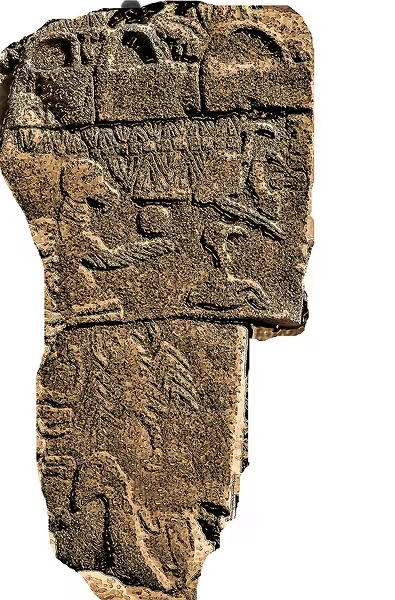
Of all the pillars at Göbekli Tepe, none has captured more attention — from archaeologists, astronomers, and conspiracy theorists alike — than Pillar 43, located in Enclosure D, the largest and best-preserved of the circular structures at the site.
The carving is dense and strange, and it rewards slow looking. Dominating the surface, a large vulture holds what appears to be a disc or orb in its outstretched wing — watchful, deliberate, unmistakably symbolic. Below it crouches a scorpion. To the side, a headless human figure. Other animals crowd the remaining surface: cranes in procession, a fox, another man without a head.
What does it mean? Interpretations vary enormously — and the quality of those interpretations varies just as much.
The most grounded reading, favored by researchers at the German Archaeological Institute (DAI), is that the carvings are cosmological in nature: a visual language encoding beliefs about death, the afterlife, and the movement of the sky. The vulture in particular recurs across ancient Near Eastern symbolism as a psychopomp — a guide of souls between worlds.
A 2017 paper by Martin Sweatman and Dimitrios Tsikritsis proposed a more specific and more contested interpretation: that Pillar 43 encodes an astronomical “date stamp” marking a comet impact around 10,950 BCE, and that the animal figures correspond to constellations. More recently, a 2024 study suggested the V-shaped marks on the pillar could represent a lunisolar calendar — potentially one of the oldest known. These theories are intriguing but remain outside the mainstream of academic archaeology; most specialists regard them as speculative.
What is not speculative is that Pillar 43 demonstrates an intellectual and symbolic life among its makers that sits uncomfortably with the word “primitive.”
What we know about the burial
The deliberate burial of Göbekli Tepe is one of the clearest facts about the site — and one of its deepest mysteries.
Hilltops erode. Sediment does not accumulate on them naturally. Yet Göbekli Tepe was found buried under meters of fill material, systematically packed around and over the enclosures. This fill contained animal bones, flint tools, and other debris of human activity — not the random accumulation of wind and time, but the product of organized human effort.
Crucially, the burial was not a single event. Excavations show it happened in stages: older enclosures were filled in while newer ones were being constructed on top of them. The site grew upward across what may have been centuries, each layer of construction eventually buried beneath the next, until the entire complex was sealed and abandoned around 8000 BCE.
Three theories — and what they disagree about
Archaeologists broadly agree on what happened. The why divides them.
Ritual closure
The most widely accepted interpretation is that the burial was a deliberate act of sacred significance — a formal way of “closing” a site once its ritual function had been fulfilled. In many ancient cultures, decommissioning a sacred space required a closing act, not simple abandonment. Lee Clare of the DAI, who has led excavations at the site since Schmidt’s death, has described the burial as consistent with practices of ritual termination known from other prehistoric contexts: the site was not abandoned, it was concluded.
Architectural memory
A second interpretation reads the evidence less as closure and more as continuity. Rather than a single terminal act, the progressive filling-in of enclosures may have been a way of honoring and preserving the past — physically incorporating the old into the foundations of the new. The site did not end; it accumulated. The burial, in this reading, was a form of reverence.
A rupture in belief
A third possibility is that the burial reflects not continuity but break: a shift in religious or cosmological thinking significant enough to make the old structures not just obsolete, but actively in need of neutralizing. Filling them in would then have been a way of managing that transition — not honoring the past, but closing a chapter on it.
No consensus has been reached. Until more of the site is excavated — and it is worth repeating that we have seen less than ten percent of what is there — the question remains genuinely open.
Why it still matters
Göbekli Tepe forces a question that archaeology is still learning to ask: what did these people believe, and how did those beliefs organize their world?
The carvings on the pillars — dense, deliberate, carved by people who clearly knew what they wanted to say — are a message in a language we have not yet learned to read. The burial adds a further layer: whoever sealed the site chose to preserve it rather than quarry the stones for new construction. They wanted it kept.
The next decades of excavation may answer some of what Göbekli Tepe is asking. Or they may only deepen the question. Either way, the site has already done what the greatest historical discoveries do: it has made the past stranger, and larger, than we imagined.
Göbekli Tepe is a UNESCO World Heritage Site. Ongoing excavations are conducted by the German Archaeological Institute (DAI) in partnership with the Turkish Ministry of Culture and Tourism.
Sources : World History Encyclopedia · Smithsonian Magazine · Archaeology Magazine, May/June 2021 · Phys.org — Sweatman & Tsikritsis 2017 · Arkeonews — étude 2025 · gobekli-tepe.com — Pillar 43
