
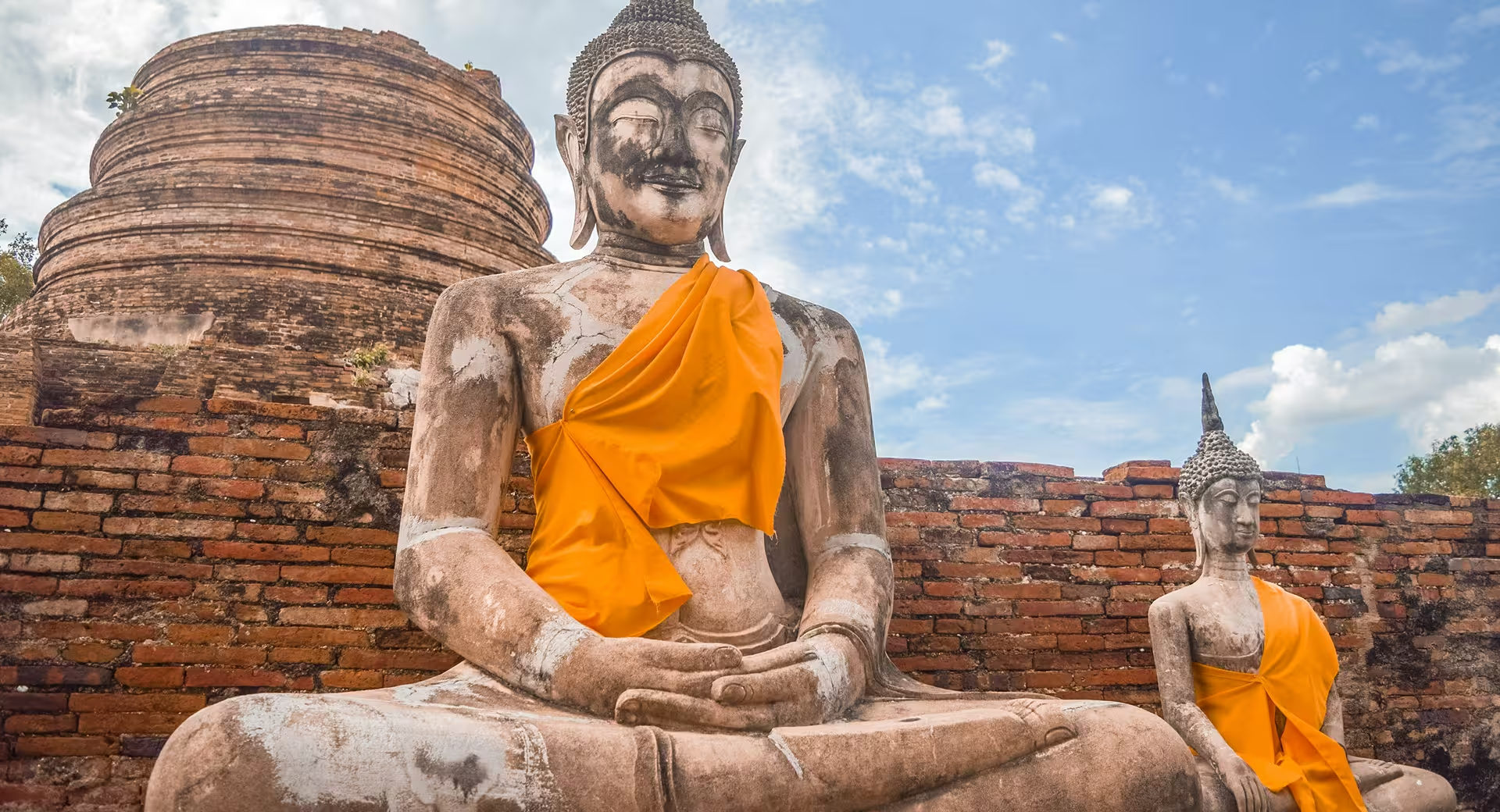
The History of Meditation: A Fascinating 5,000-Year Journey From India to Your Phone
The history of meditation is older than writing, older than most religions, and considerably older than the wellness industry that now sells it back to us. It is presented as a modern solution to a modern problem: the overwhelmed, distracted, overstimulated mind. But the practice itself is not modern at all. It is, by most accounts, one of the oldest sustained human activities on record — older than writing, older than most religions, possibly older than the wheel.
Where meditation comes from is a question with a surprisingly complicated answer. The honest version involves five thousand years, at least half a dozen civilizations, and several moments where the practice almost disappeared entirely before resurfacing in a new form. It also involves, at the end, one of the strangest cultural transfers of the twentieth century.
The earliest evidence
The oldest physical evidence of meditation-like practice comes not from a text but from an image. Among the archaeological remains of the Indus Valley civilization — one of the ancient world’s great urban cultures, centered in what is now Pakistan and northwest India — researchers have found seals and wall art depicting figures seated in postures that closely resemble what we would recognize today as meditation: cross-legged, spine erect, hands resting on knees, eyes half-closed. The most famous is the Pashupati seal, dated to around 2500 BCE, showing a horned figure in what many scholars interpret as a yogic posture.
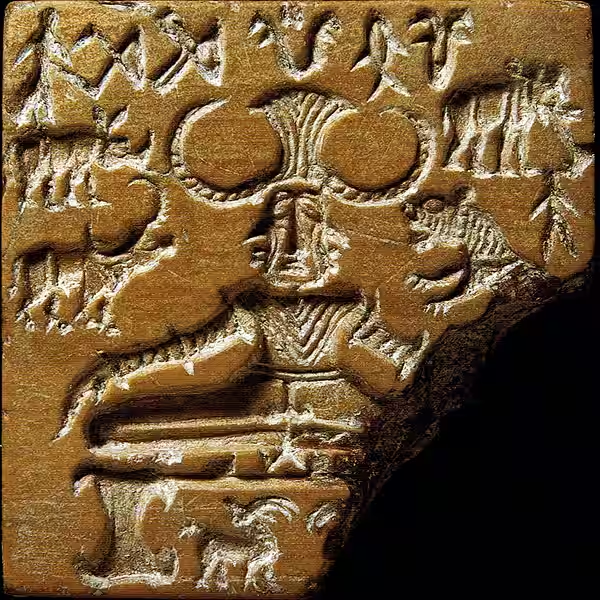
These images cannot tell us what the people who made them were doing internally. But the postures are deliberate, formal, and repeated across multiple artifacts — suggesting not casual sitting, but a codified practice with recognized forms.
The first written accounts come later, from the Vedas: the ancient sacred texts of the Indian subcontinent, transmitted orally for centuries before being committed to writing around 1500 BCE. The Vedic tradition introduced the concept of dhyana — a Sanskrit term meaning, roughly, contemplative absorption — as a method for understanding the nature of mind and its relationship to the cosmos. This was not relaxation. It was epistemology: a way of knowing, practiced as rigorously as any philosophical inquiry.
The Buddhist turn in meditation history
The history of meditation changes shape decisively in the 5th century BCE, with the figure of Siddhartha Gautama — the Buddha.
Born into a noble family in what is now Nepal, Gautama left his privileged life after confronting the realities of aging, illness, and death. He spent years studying with Vedic teachers and practicing extreme asceticism before arriving, through his own investigation, at what he called the Middle Way: a discipline of sustained, systematic attention to experience, neither indulgent nor punishing. The practice of vipassana — insight meditation, the direct observation of mental phenomena as they arise — became central to Buddhist teaching.
What Buddhism did that Vedic tradition had not was to systematize and, crucially, democratize meditation. In the Vedic context, contemplative practice was largely the domain of a priestly class. The Buddha taught monks, merchants, farmers, and women. His instructions were practical and concrete: sit, observe the breath, notice when the mind wanders, return. The psychological sophistication of his analysis of mind — detailed in texts like the Satipatthana Sutta — remains striking to contemporary psychologists and neuroscientists who have studied it.
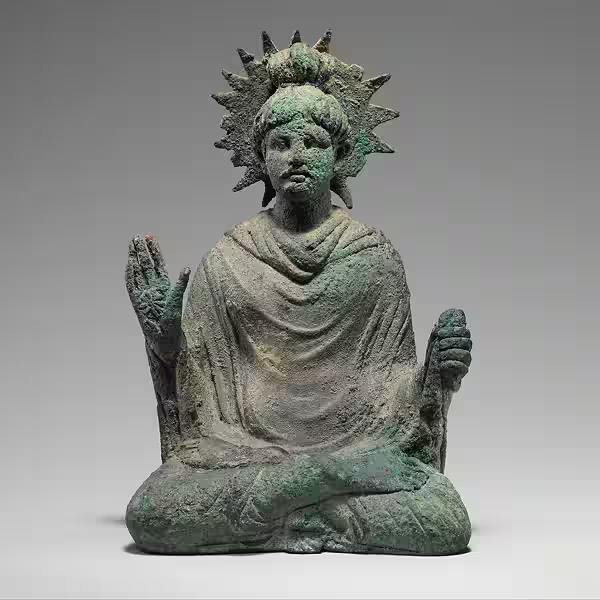
Buddhism spread along trade routes: into Sri Lanka, Southeast Asia, China, Korea, Japan. As it moved, it adapted. In China it merged with Taoist traditions of stillness and breath-work to produce Chan Buddhism, which in Japan became Zen.
Each iteration retained the core of sustained attention to present experience but wrapped it in different philosophical and aesthetic frameworks.
The contemplative traditions of other worlds
It would be a mistake to treat meditation as exclusively an Indian or Buddhist invention.
Around the same period that Buddhism was developing in India, contemplative traditions were emerging independently elsewhere. The ancient Egyptians had practices of focused inner silence connected to temple ritual. Jewish mysticism developed forms of concentrated prayer and visualization that scholars describe as structurally similar to meditation.
The philosopher-emperor Marcus Aurelius, in his private journals — now published as the Meditations — described a practice of withdrawing attention from external events and returning it to principles already known. He would not have called it meditation. But the practice of deliberate, disciplined self-observation, conducted in writing and in silence, is recognizable across the distance of two millennia.
The Desert Fathers of early Christianity — monks who retreated to the Egyptian and Syrian desert in the 3rd and 4th centuries CE — practiced hesychasm: a method of interior silence and breath-linked prayer that bears remarkable resemblance to what was happening in Indian monasteries at the same time, though there is no clear evidence of direct contact.
Hesychasm was further practiced during the Middle Ages, especially in monasteries or by hermits, sometimes in extreme forms like stylitism — people retiring from the world and living atop columns or pillars.
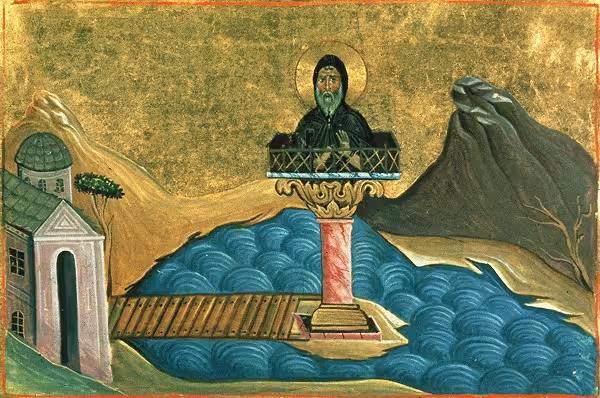
The human mind, it appears, has arrived at similar solutions to similar problems in more than one place.
How eastern meditation reached the West
For most of its history, meditation in its formal sense remained largely unknown in Europe and the Americas. That changed in the second half of the nineteenth century, when the first translations of Buddhist and Hindu texts began circulating among Western intellectuals — Ralph Waldo Emerson and Henry David Thoreau were among the early readers, and Thoreau’s Walden shows clear traces of his engagement with the Bhagavad Gita.
But the real transfer came in the twentieth century, in two waves.
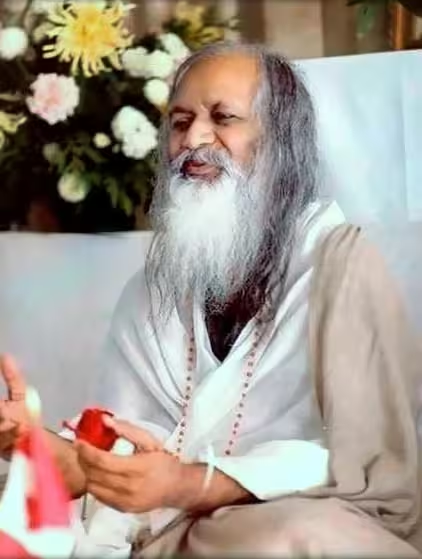
The first was intellectual and countercultural. In the 1950s and 1960s, figures like D.T. Suzuki brought Zen to Western audiences through lectures and books. Alan Watts popularized Eastern philosophy for readers who had never heard of the Vedas. And in 1968, the Beatles traveled to Rishikesh, India, to study Transcendental Meditation with Maharishi Mahesh Yogi — an event that generated more mainstream Western interest in meditation than anything that had preceded it.
The second wave was scientific. Beginning in the 1970s, researchers — most notably Jon Kabat-Zinn at the University of Massachusetts — began stripping meditation of its religious context and studying it as a clinical intervention. Kabat-Zinn’s Mindfulness-Based Stress Reduction (MBSR) program, launched in 1979, repackaged Buddhist vipassana as a secular, evidence-based therapy. It worked: decades of research have documented measurable effects on stress, anxiety, chronic pain, and attention.
This is the version of meditation that arrived on your phone.
What got lost, and what survived
The journey from Indus Valley seal to mindfulness app is not a story of straightforward transmission. It involved translation, adaptation, simplification, and at times significant distortion. The original frameworks — complex philosophical systems concerned with the nature of consciousness and liberation from suffering — have been largely set aside in the Western clinical version. What remains is the technique: the deliberate direction of attention, the observation of mental events, the return from distraction.
Whether that is a diminishment or a refinement depends on what you think meditation is for.
What is clear is that the core practice — sitting quietly, watching the mind, noticing what arises — has proven durable across five millennia and at least half a dozen civilizations. Something in it has repeatedly struck human beings as worth doing, worth teaching, and worth preserving.
That is not nothing. In the history of human ideas, very few things last that long.
The academic study of meditation’s history draws on archaeology, textual scholarship, and cognitive science. Key researchers include Johannes Bronkhorst (ancient Indian meditation traditions) and Bhikkhu Analayo (Buddhist contemplative practices).
Sources : Positive Psychology — History of Meditation · Live and Dare — 5,000 Years Timeline · Mindworks — History & Origins · News Medical — Meditation History · Hello My Yoga — Full Timeline