
Forest Bathing: 5 Proven Ways Shinrin-Yoku Changes Your Body and Mind
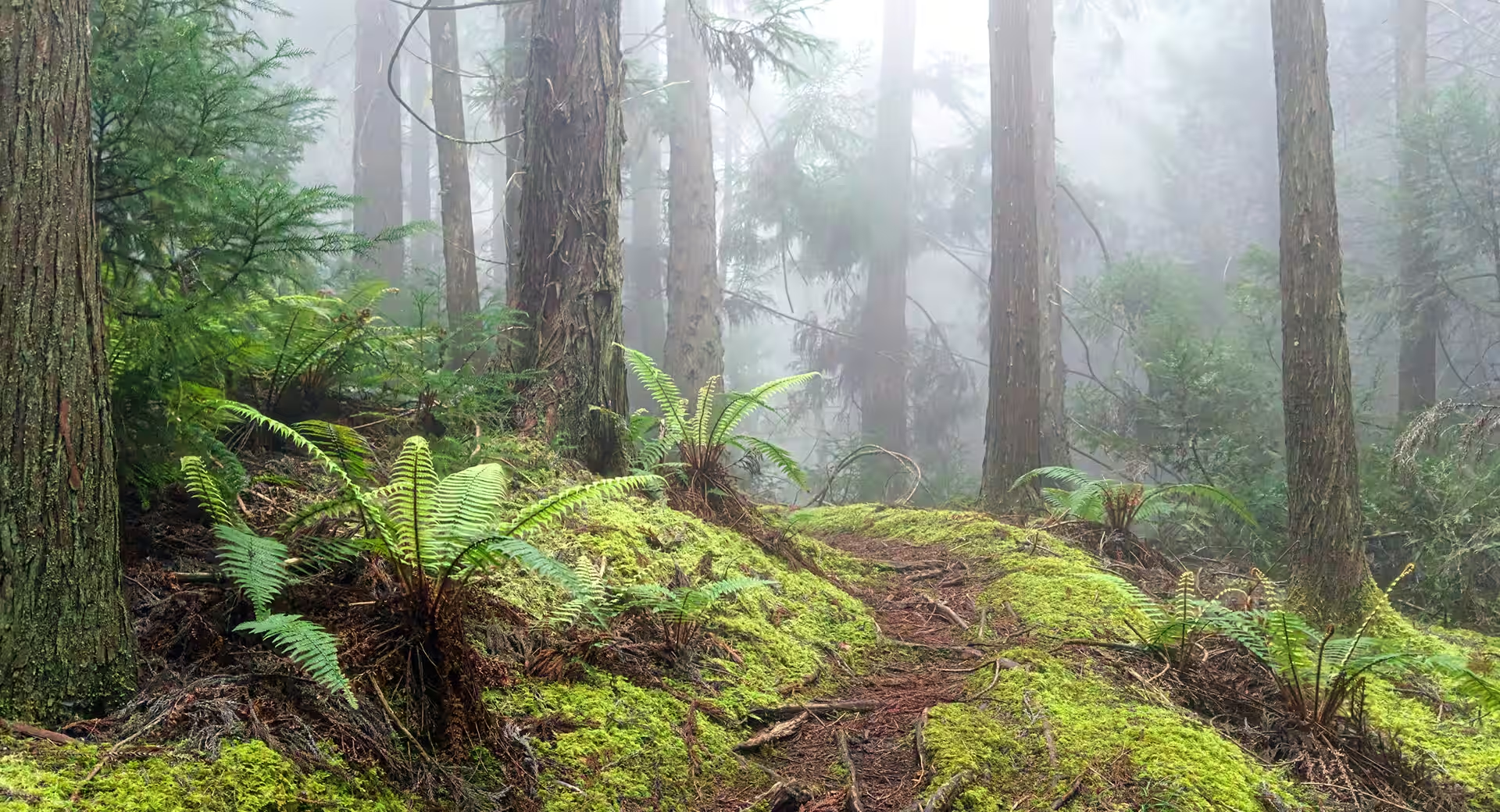
In 1982, the Japanese Ministry of Agriculture, Forestry and Fisheries coined a term: shinrin-yoku. Literally “forest bathing” — though no water is involved. The idea was straightforward: spend time in a forest, moving slowly, using your senses. Not hiking to a summit, not exercising toward a goal. Just being among trees.
It sounded, to many Western ears, like poetry dressed up as policy. Over the following four decades, a substantial body of scientific research has suggested it is something more than that.
Where the idea came from
© Σ64, CC-by-SA 3.0
Japan in the early 1980s was a country of rapid urbanization and rising rates of what the Japanese called karoshi — death from overwork. The government was looking for ways to encourage people to use the country’s extensive forests, which cover roughly two-thirds of Japan’s land area, for health purposes. Shinrin-yoku was the answer: a formalized practice of therapeutic forest immersion, supported by state infrastructure and, eventually, serious research funding.
The practice draws on older roots. Shinto and Buddhist traditions have long held forests to be sacred, inhabited by spirits, deserving of reverence and stillness. What was new in 1982 was the attempt to subject that intuition to scientific measurement.
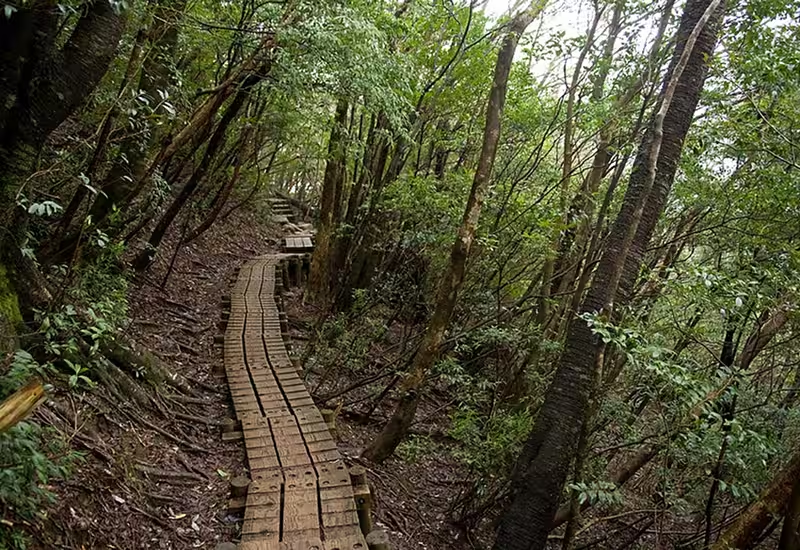
The first systematic experiments were conducted in 1990 by Yoshifumi Miyazaki, a researcher at Chiba University, on the island of Yakushima — a UNESCO World Heritage Site of ancient cedar forest off the southern coast of Kyushu. Miyazaki’s team measured physiological responses to forest environments versus urban environments: stress hormones, heart rate, blood pressure, immune markers. What they found would set the agenda for decades of subsequent research.
What the research actually shows
The science of forest bathing now spans hundreds of peer-reviewed studies across multiple countries. The findings cluster around a few consistent effects.
Cortisol and the stress response. Research from Chiba University found that participants who spent time in a forest environment had significantly lower salivary cortisol levels — an established marker of physiological stress — compared to those who spent equivalent time in urban settings. One frequently cited study found a reduction of approximately 12.4% in cortisol after forest immersion. Heart rate fell by 5-7%, and blood pressure followed.
The immune system. The most striking findings concern natural killer cells — a type of white blood cell that plays a central role in the body’s defense against viral infections and certain cancers. Research by Dr. Qing Li at the Nippon Medical School in Tokyo found that a three-day forest immersion trip produced a roughly 50% increase in NK cell activity in participants. More remarkably, this effect persisted: NK activity remained elevated for up to four weeks after a single multi-day trip. A one-day forest visit showed immune-boosting effects lasting approximately one week.

The autonomic nervous system. Multiple studies have documented a shift toward parasympathetic dominance — the “rest and digest” state, as opposed to the “fight or flight” sympathetic response — during and after forest exposure. This shift underlies many of the observed effects on heart rate and cortisol.
A 2025 review published in the journal Health synthesized the accumulated evidence and concluded that shinrin-yoku shows significant effects on immune modulation, stress regulation, and neurocognitive resilience — while also noting that study designs vary and that more standardized research protocols are needed.
Why your brain already knows how to be in a forest
The effects described above are real and measurable — but they prompt a deeper question: why does the human body respond to forests this way at all? The answer lies not in Japanese health policy but in evolutionary history.
Homo sapiens has existed for roughly 300,000 years. For the vast majority of that time — perhaps 95% of our species’ existence — our ancestors lived in forested and savanna environments in Africa, where survival depended on reading natural landscapes with extraordinary precision: identifying edible plants, tracking animals, sensing predators, finding water. The human nervous system evolved inside nature. It was calibrated by nature. Urban environments, by contrast, have existed for a few thousand years at most — a negligible interval in evolutionary terms.
The biologist E.O. Wilson formalized this idea in 1984 under the term biophilia: an innate human tendency to seek connection with other living systems, rooted in the fact that our survival once depended on it. Wilson argued that our attraction to natural environments — to trees, water, open sightlines, the sound of birdsong — is not aesthetic preference but evolutionary inheritance. We are drawn to the landscapes that kept our ancestors alive.
The flip side of this is what researchers call evolutionary mismatch: the stress, attentional fatigue, and chronic low-level arousal that characterize urban life may reflect, in part, a nervous system operating in an environment it was not designed for. The noise, visual complexity, social density, and constant demands for directed attention in cities are genuinely novel stimuli — and the brain handles novelty with vigilance, which is metabolically expensive and physiologically wearing.
This is where psychologists Rachel and Stephen Kaplan’s Attention Restoration Theory, developed in the 1980s, becomes relevant. The Kaplans observed that natural environments engage what they called soft fascination — a gentle, effortless form of attention drawn by inherently interesting but non-demanding stimuli: rustling leaves, moving water, shifting light through a canopy. This type of attention requires no cognitive effort, which means the brain’s directed attention systems — depleted by work, screens, and urban decision-making — are free to rest and recover. Nature does not just relax us. It restores a specific cognitive capacity that modern life continuously erodes.
Forest bathing, in this light, is not a wellness trend. It is a return to the conditions under which the human mind learned to function.
Phytoncides: what the trees are actually doing
One of the more surprising findings in shinrin-yoku research concerns not what people do in forests, but what forests do to people.

Trees — particularly conifers like cedar, pine, and cypress — emit airborne chemical compounds called phytoncides. These are part of the tree’s own immune system: antimicrobial agents the plant releases to defend itself against bacteria, insects, and fungi. When humans breathe them in, phytoncides appear to trigger measurable changes in immune function, including increased NK cell activity.
Dr. Li demonstrated this in a controlled study: hotel room diffusers emitting hinoki cypress oil produced similar immune effects to actual forest immersion, without any of the other variables — no greenery, no birdsong, no exercise, no change in light. The phytoncides, inhaled overnight, were sufficient to produce a statistically significant increase in NK cell activity.
This suggests that at least part of what forest bathing does is pharmaceutical in nature — not metaphorical, not placebo, but a measurable biochemical interaction between tree-produced compounds and human immune cells. The forest is, in this sense, medicating its visitors.
Touch is part of the picture too. The practice of physically embracing trees — which in popular culture carries the baggage of cliché but has been practiced in various forms across Japanese, Nordic, and indigenous traditions — has begun attracting its own research attention. A 2023 study found that forest bathing significantly increased blood oxytocin levels — the hormone associated with bonding, trust, and social calm — alongside serotonin, while also reducing subjective fatigue and improving sleep quality. Physical contact with bark, moss, and soil engages sensory pathways that are distinct from the respiratory uptake of phytoncides, suggesting that the full-body, multi-sensory nature of forest immersion matters: sight, sound, smell, and touch each appear to contribute through different mechanisms.
What it does not explain
The phytoncide mechanism is compelling, but it does not account for all of the observed effects.
Studies conducted in parks without significant tree cover, beside rivers, and in non-forested natural environments have found similar, if sometimes smaller, reductions in cortisol and improvements in mood. Exposure to natural light, the color green, the sound of water, birdsong, and the simple absence of traffic noise all appear to contribute independently to stress reduction. The field of environmental psychology has identified this cluster of effects under the broader concept of attention restoration theory — the idea, developed by psychologists Rachel and Stephen Kaplan in the 1980s, that natural environments restore directed attention capacity depleted by the demands of urban life.
What this means practically is that the benefits of time in nature are probably not uniquely dependent on forests. But forests appear to amplify them — and the phytoncide evidence suggests they do so through a mechanism unavailable in other natural settings.
How much time does it take?
Dr. Li’s research offers some concrete figures. The relaxing effects of forest immersion begin to appear approximately 20 minutes after entering the forest. A minimum of two hours is needed to produce measurable immune-boosting effects. A full day — around six hours — produces effects that last approximately one week. Three days produces effects lasting up to four weeks.
These are averages from controlled studies, not prescriptions. But they suggest something useful: that even a single afternoon in a forest is not trivial, and that the effects accumulate with frequency.
A practice, not a cure
Shinrin-yoku is not a medical treatment, and the research does not position it as one. The studies measure population averages across healthy participants; individual responses vary. The practice sits within a broader body of evidence for the health benefits of time in nature — evidence that is suggestive and growing, but that does not yet support clinical recommendations for specific conditions.
What the research does support is the intuition that most of us have had at some point: that time among trees feels different from time in cities, in ways that seem to go beyond preference or imagination. The science has spent four decades trying to understand what that difference is. It has found, so far, a partial answer — part chemistry, part neuroscience, part attention — and a consistent pattern of effects that are real, measurable, and worth taking seriously.
The forests have been there all along. The research is just beginning to explain what they were doing.
This article is informational and does not constitute medical advice. If you have health concerns, please consult a qualified healthcare professional.
Sources : PMC — Forest Bathing and Preventive Medicine 2025 · PMC — Forest Medicine review · PMC — Systematic review shinrin-yoku · Greater Good Berkeley — Why Forest Bathing Is Good for Your Health · Nippon.com — Yoshifumi Miyazaki · UNature — Dr. Qing Li interview PMC — Biophilia as Evolutionary Adaptation · Frontiers in Psychology — Biophilic Design · PMC — Meta-Analysis Biophilia Hypothesis ANFT — Science-Based Benefits of Forest Bathing · Wellicious — Tree Hugging Therapy