

Does Consciousness Precede Matter? What the Science Actually Shows
In 1998, neuroscientist Christof Koch made a bet with philosopher David Chalmers. A case of fine wine said that within twenty-five years, science would find the exact spot in the brain where consciousness lives — a clean, physical signature separating a conscious brain state from an unconscious one. Twenty-five years came and went. In 2023, in front of an audience of his peers, Koch conceded. Nobody had found it. Nobody was close.
That concession is a good place to start, because it tells you something most popular science writing about consciousness doesn’t: this isn’t a solved problem wearing a thin disguise of mystery. It’s a genuinely open one, sitting at the point where neuroscience runs out of road and philosophy has to take over. And in the last few years, the field has actually done something rare in a debate this old — it ran a real test, got a real result, and the result was that both of its leading theories were wrong, or at least badly incomplete.
This piece looks at three things. First, what the two dominant scientific theories of consciousness actually claim, and what happened when researchers finally pitted them against each other directly. Second, the older and stranger question underneath all of it: whether consciousness is something the brain produces, or something the brain merely channels — in other words, whether mind or matter came first. Third, why this isn’t just an academic curiosity anymore, because the same unresolved question is now sitting at the center of debates about whether AI systems could ever be conscious.
Two theories, one brain
For most of the last decade, two frameworks have dominated the science of consciousness, and they disagree about almost everything.
The first is Global Neuronal Workspace Theory (GNWT), developed from Bernard Baars’ original global workspace model. The idea is architectural: your brain is full of specialized systems processing information in parallel — vision, hearing, memory, language — mostly outside of awareness. Consciousness, on this view, is what happens when a piece of information gets promoted out of one of those local systems and broadcast widely across the brain, particularly through fronto-parietal networks, making it available to memory, planning, and verbal report all at once. Something becomes conscious not because of what it is, but because of how far it travels. GNWT is a theory about access — about the brain’s internal spotlight.
The second is Integrated Information Theory (IIT), developed by Giulio Tononi. IIT starts from the opposite end. Instead of asking which brain regions light up during conscious experience, it asks what mathematical property a system needs to have in order to support experience at all. Tononi’s answer is integration: a system is conscious to the degree that its parts are richly interconnected in a way that can’t be broken down into independent components without losing information. He gives this quantity a symbol, Phi (Φ), and the theory’s boldest claim is that Φ isn’t just correlated with consciousness — it is consciousness. A thermostat has a whisper of Φ. A human brain has an enormous amount. In principle, so might a sufficiently interconnected computer chip, which is part of why IIT has drawn so much attention from people thinking about machine consciousness.
These aren’t small differences in emphasis. GNWT is a theory about function — what conscious information does once it’s conscious. IIT is a theory about intrinsic being — what a system is by virtue of its structure, independent of any function at all. A system could, in principle, have high Φ and never do anything with the information; IIT would still call it conscious. GNWT would not.
The disagreement got heated enough that in September 2023, more than 100 researchers signed an open letter calling IIT unscientific, on the grounds that its central claims aren’t falsifiable with any technology we currently have. The label used was blunt: pseudoscience. IIT’s defenders, including consciousness researcher Anil Seth, pushed back hard in the pages of Nature Neuroscience, arguing that boldness and a willingness to be wrong are exactly what a genuinely difficult problem like consciousness requires. The exchange became known, only half-jokingly, as an attempted “scientific excommunication.”
The test nobody expected to be this humbling
Rather than let the dispute stay a war of position papers, a group of researchers did something unusual: they got both camps to agree, in advance, on an experiment that could distinguish between their theories — and then ran it.
This was the 2023 Adversarial Collaboration, coordinated through the Templeton World Charity Foundation and a theory-neutral consortium of scientists who had no stake in either theory winning. Proponents of GNWT and IIT worked together to design a study whose outcome each side agreed, beforehand, would count as evidence for or against their position. That’s a genuinely rare thing in science generally, let alone in a field as contested as consciousness research.
Two hundred fifty-six participants watched simple visual stimuli — faces, objects, letters — for varying lengths of time while researchers recorded their brain activity using three different methods simultaneously: functional MRI for spatial detail, magnetoencephalography for timing, and in some cases intracranial electroencephalography, recording directly from the surface of the brain. The idea was to look for exactly the signatures each theory predicted. GNWT predicted a late, sustained burst of activity in prefrontal cortex when something became consciously perceived — the “broadcast” moment. IIT predicted sustained, synchronized activity concentrated in posterior, sensory regions, without needing the frontal lobes to be involved at all.
The results, published in Nature in 2025, didn’t cleanly vindicate either side. Researchers did find information about what was consciously perceived in visual and ventral temporal cortex, and they found content-specific synchronization — pointing partially toward IIT’s predictions about posterior brain regions. But they also found sustained activity tied to how long a stimulus was shown, and signals in inferior frontal cortex that GNWT’s model would predict and IIT’s would not. Neither theory’s account fully matched what the brain actually did. The verdict that has circulated through science coverage into 2026 is consistent: this was a well-run, honest test, and it showed that the two leading theories of consciousness both fail to fully explain the neural data.
That’s not a failure of the experiment. If anything, it’s the field growing up. For years, consciousness science operated more like competing schools of thought defending their turf than like a normal experimental science converging on an answer. The adversarial collaboration format — pre-registering what would count as a win or a loss before the data comes in — is exactly the kind of self-correcting rigor the field needed, and its result, however anticlimactic, is more trustworthy for being inconclusive rather than triumphant.
It’s also worth naming what this doesn’t mean. It doesn’t mean either theory is dead. GNWT and IIT remain the two most influential frameworks in the field, alongside a handful of others worth knowing: Higher-Order Theories, which hold that a mental state becomes conscious only when the brain represents itself as having that state — a thought about a thought; Recurrent Processing Theory, which locates consciousness in feedback loops within sensory cortex rather than in any broadcast to the front of the brain; and Predictive Processing accounts, which frame conscious experience as the brain’s best current guess about the causes of its sensory input, constantly checked against incoming data. None of these has resolved the debate either. What the adversarial collaboration did was rule out easy victories — and force the field to admit that the neural correlates of consciousness are more distributed, more theory-dependent, and more stubborn than any single framework currently captures.
What the edge cases teach us
One reason GNWT and IIT have stayed useful despite neither one being confirmed is that they make different, testable predictions about the boundary cases where consciousness flickers — general anesthesia, deep sleep, coma, and the altered states produced by psychedelics. These edge cases matter because they let researchers study the on/off switch directly, rather than debating consciousness only in its default, always-on state.
Under general anesthesia, brain activity doesn’t simply go quiet — different anesthetic drugs disrupt different things, which is itself informative. Propofol tends to disconnect frontal and posterior brain regions from each other, consistent with GNWT’s prediction that consciousness depends on wide-scale communication across the brain, not just activity within any one region. Patients in a vegetative state who show no outward signs of awareness sometimes show, on closer inspection with fMRI, patterns of brain activity that look startlingly similar to a healthy person’s when asked to imagine playing tennis — a finding that has forced clinicians to reconsider how confidently anyone can declare a person entirely without awareness based on behavior alone. That gap between outward behavior and inward state is precisely the gap both GNWT and IIT are trying, in different ways, to close.
Psychedelics complicate the picture further rather than simplifying it. Compounds like psilocybin and LSD produce states that subjects consistently describe as more vivid and expansive than ordinary waking consciousness, not less — despite measurably reducing certain kinds of organized, synchronized brain activity, particularly in networks associated with self-referential thought. That’s an odd result for any theory that ties richer consciousness straightforwardly to more integration or more broadcasting: here, subjectively heightened experience seems to coincide with less of the very organization some theories treat as consciousness’s signature. It’s one of the more genuinely puzzling data points in the field, and it’s part of why some researchers have grown cautious about betting everything on either IIT’s integration metric or GNWT’s broadcast model as the whole story.
None of these edge cases settle the deeper question of whether mind or matter is fundamental — they’re still physicalist experiments, measuring correlations between brain states and reported experience. But they do something valuable: they keep the field honest about how much remains unexplained even at the purely descriptive level, before the harder metaphysical question is even on the table.
The question neuroscience can’t touch
Here’s the deeper issue lurking underneath all of this experimental work, and it’s the one you actually asked about: does consciousness come before matter, or after it?
Every theory discussed so far — GNWT, IIT, Higher-Order Theories, Predictive Processing — shares a hidden assumption. They all take it for granted that the physical brain comes first, and consciousness is something that arises from it, somehow, once the physical arrangement gets complicated or integrated or self-referential enough. This assumption has a name: physicalism. It holds that everything in the universe, mental phenomena included, ultimately reduces to physical stuff and its interactions. It’s the default working assumption of essentially all of modern science, for good historical reason — it’s the framework that gave us the scientific method itself, built by figures like Bacon, Galileo, and Newton as a deliberate break from supernatural explanation.
But physicalism has one persistent, famous hole in it, known as the hard problem of consciousness, a term coined by Chalmers in the 1990s. Science can explain, in principle, how the brain processes information, how neurons fire, how attention shifts, how memory forms — these are “easy” problems in the sense that they’re mechanistic, even if technically difficult. What physicalism has never managed to explain is why any of that processing is accompanied by subjective experience at all. Why does information integration feel like something from the inside, rather than happening in the dark, the way it does inside a calculator? There’s no obvious bridge from “neurons doing complicated things” to “someone is home experiencing red.” That gap is the hard problem, and forty years after it was named clearly, it hasn’t closed.
This is where idealism enters, not as a fringe position but as a serious, actively defended one in contemporary philosophy of mind. Idealism inverts the physicalist assumption entirely: instead of trying to explain how mind emerges from matter, it starts from the one thing that’s genuinely undeniable — that experience is happening right now, to you, reading this — and treats that as the fundamental fact of reality.
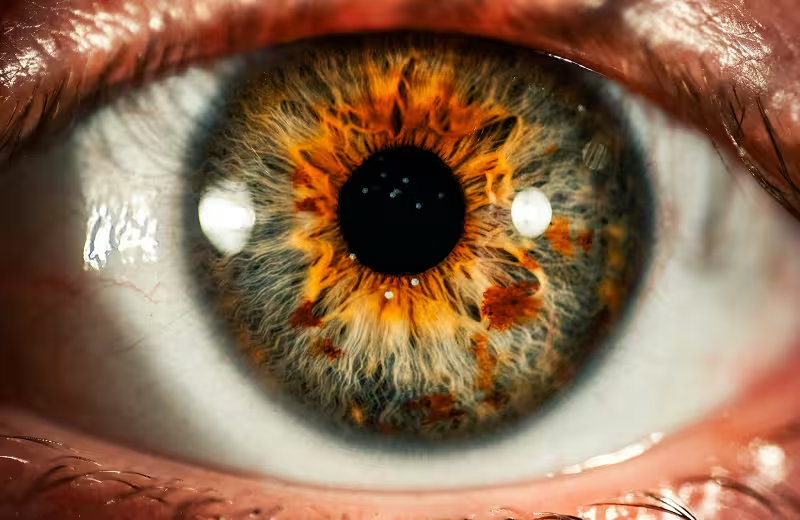
On this view, the physical world isn’t the base layer that consciousness somehow bubbles up from; it’s closer to the outward appearance, or expression, of something mental at its root. Matter is what mind looks like from the outside, not the other way around. Philosopher Bernardo Kastrup is probably the most visible contemporary defender of this position, arguing that flipping the causal arrow this way doesn’t just avoid the hard problem — it dissolves it, since there’s no longer a gap to explain between matter and mind if mind was never derived from matter in the first place.
But physicalism has one persistent, famous hole in it, known as the hard problem of consciousness, a term coined by Chalmers in the 1990s. Science can explain, in principle, how the brain processes information, how neurons fire, how attention shifts, how memory forms — these are “easy” problems in the sense that they’re mechanistic, even if technically difficult. What physicalism has never managed to explain is why any of that processing is accompanied by subjective experience at all. Why does information integration feel like something from the inside, rather than happening in the dark, the way it does inside a calculator? There’s no obvious bridge from “neurons doing complicated things” to “someone is home experiencing red.” That gap is the hard problem, and forty years after it was named clearly, it hasn’t closed.
This is where idealism enters, not as a fringe position but as a serious, actively defended one in contemporary philosophy of mind. Idealism inverts the physicalist assumption entirely: instead of trying to explain how mind emerges from matter, it starts from the one thing that’s genuinely undeniable — that experience is happening right now, to you, reading this — and treats that as the fundamental fact of reality. On this view, the physical world isn’t the base layer that consciousness somehow bubbles up from; it’s closer to the outward appearance, or expression, of something mental at its root. Matter is what mind looks like from the outside, not the other way around. Philosopher Bernardo Kastrup is probably the most visible contemporary defender of this position, arguing that flipping the causal arrow this way doesn’t just avoid the hard problem — it dissolves it, since there’s no longer a gap to explain between matter and mind if mind was never derived from matter in the first place.
A live example of how contested this territory is, even within hard science, surfaced in late 2025. Maria Strømme, a professor of materials science and nanotechnology at Uppsala University, published a paper in AIP Advances arguing that consciousness is a fundamental field underlying space, time, and matter — a formally mathematized version of the idealist position, coming not from a philosopher but from one of the Nordic region’s most-cited materials scientists, with a career built on nanotechnology rather than metaphysics. The paper was well received on its own terms; it was even selected as the issue’s best paper. It also drew sharp criticism from physicists almost immediately. In May 2026, following scrutiny from the Swedish newspaper Dagens Nyheter, AIP Publishing retracted it, stating that the theory’s central mathematical operator had no associated measurable quantity and that its predictions could not be empirically verified or falsified — as the retraction notice put it, a postulated theory that cannot be falsified does not meet the standard for scientific validity. That’s essentially the same objection critics have leveled at IIT’s treatment of Φ, and the episode is a useful reminder that credentials in one hard science don’t inoculate a theory of consciousness from the field’s core requirement: it has to be falsifiable, or it isn’t science yet, however elegant the mathematics look on the page.

Sitting between physicalism and idealism is panpsychism, which doesn’t go as far as saying mind is the only fundamental reality, but does propose that some rudimentary form of experience is a basic property of matter itself — present, in trace amounts, in everything, not just brains. This isn’t as strange a position among physicists and philosophers as it might sound; it’s partly an attempt to explain how complex consciousness could ever emerge from a universe of matter if that matter didn’t already have some proto-experiential quality baked in from the start. It’s also the position IIT’s critics keep circling back to, since Tononi’s Φ effectively assigns nonzero consciousness to any system with enough internal integration — a thermostat, a logic gate, potentially a sufficiently interconnected network of any kind. IIT was built as a physicalist, empirically-grounded theory. Its critics argue its own math quietly smuggles panpsychism in through the back door.
None of these positions can currently be settled by an experiment, and that’s not a temporary limitation waiting on better brain-scanning technology — it may be a structural one. Every measurement neuroscience can make is a third-person measurement: an outside observer looking at someone else’s brain activity and correlating it with that person’s reported experience. No scan can directly access anyone’s first-person experience except your own, to yourself, right now. That asymmetry is exactly why the hard problem has resisted forty years of increasingly sophisticated brain imaging: better data about correlation was never going to answer a question about which side of the correlation is fundamental. This is why the physicalism-versus-idealism debate isn’t really a scientific dispute in the ordinary sense, the kind that better instruments eventually settle. It’s closer to a question about which framework you use to interpret the data science gives you — and reasonable, well-informed people, including working physicists and neuroscientists, currently land on both sides.
So where do serious researchers actually stand?
If you’re looking for the field’s consensus position, the honest answer is that there isn’t one, and the people closest to the problem tend to be the most comfortable saying so. Anil Seth, one of the most prominent consciousness researchers working today, has been explicit that GNWT and IIT aren’t just competing explanations of the same thing — they may be answering different questions, drawing on different assumptions about what “explaining consciousness” even requires. A minority of researchers, including some physicists, take idealism seriously as a live metaphysical option, not because the data forces it, but because physicalism’s explanatory debt on the hard problem has never been paid down. The much larger majority keep working within a physicalist frame, betting that better neuroscience, better computational models, or some future integration of current theories will eventually close the gap — while acknowledging, after the 2025 adversarial collaboration, that neither of the two leading physicalist theories currently on offer does the job.
What’s changed recently isn’t that anyone has won. It’s that the field has gotten more honest about how far it still has to go, and more rigorous about testing itself instead of just arguing. That’s a genuinely healthy sign for a young science, even if it makes for a less satisfying headline.
Why an old question suddenly has new stakes
For most of the history of this debate, it stayed comfortably in philosophy departments and neuroscience labs. That’s changed, because the same unresolved questions are now unavoidable in discussions about artificial intelligence.
If IIT is right that consciousness is a matter of integrated information, then a sufficiently interconnected computer system might have some degree of consciousness regardless of what it does or doesn’t do with that information — a deeply uncomfortable idea for anyone building large-scale AI systems, since it would mean we might already be creating minds we’re not equipped to recognize. If GNWT is closer to the truth, consciousness is tied to function — broadcasting information for flexible use — which makes it at least conceivable that an AI system built the right way could genuinely qualify, not by accident, but by design. And if idealism is right, then the entire framing shifts again, since a system’s consciousness would no longer be a question of physical arrangement at all — it becomes a question about the nature of mind itself, one that a rearrangement of silicon may be permanently unequipped to touch.
Nobody actually knows which of these is closer to correct. What’s notable is that people building and studying these systems are now taking the question seriously enough to write about it directly, rather than dismissing it as science fiction. The mind-body problem, dormant in most public conversation for a generation, has become urgently practical again — not because philosophy changed, but because we built machines complex enough to force the old question back into the room.
The honest ending
Nothing in this piece resolves the question you opened with. That’s not a dodge — it’s the actual state of the field, described as accurately as the evidence allows. Neuroscience has gotten much better at describing what the brain does when something becomes conscious, and the 2025 adversarial collaboration is a genuine step forward in disciplining that description. But why any of that activity is accompanied by experience at all — and whether experience was there first, underlying everything, or whether it’s a late, local trick matter learned to perform — remains exactly as open as it was when Chalmers named the hard problem thirty years ago, and arguably as open as it’s been since philosophers first started asking the question in antiquity.
What’s different now is that we’re finally testing our assumptions instead of just defending them. That, more than any single finding, is the real story of consciousness research in 2026.
Sources consulted:
- Nature (2025), “Adversarial testing of global neuronal workspace and integrated information theories of consciousness”
- Scientific American, “Where does consciousness come from? Two neuroscience theories go head-to-head”
- Frontiers in Psychology, Baars et al. on
- Global Workspace Theory; Brain Sciences (2026), integrative review of contemporary consciousness theories
- Closer to Truth, “Idealisms — Overview”
- Philosophy A Level, “Physicalism, Dualism, and Idealism.”