
Centralia, Pennsylvania: The Real Ghost Town That Has Been on Fire Since 1962
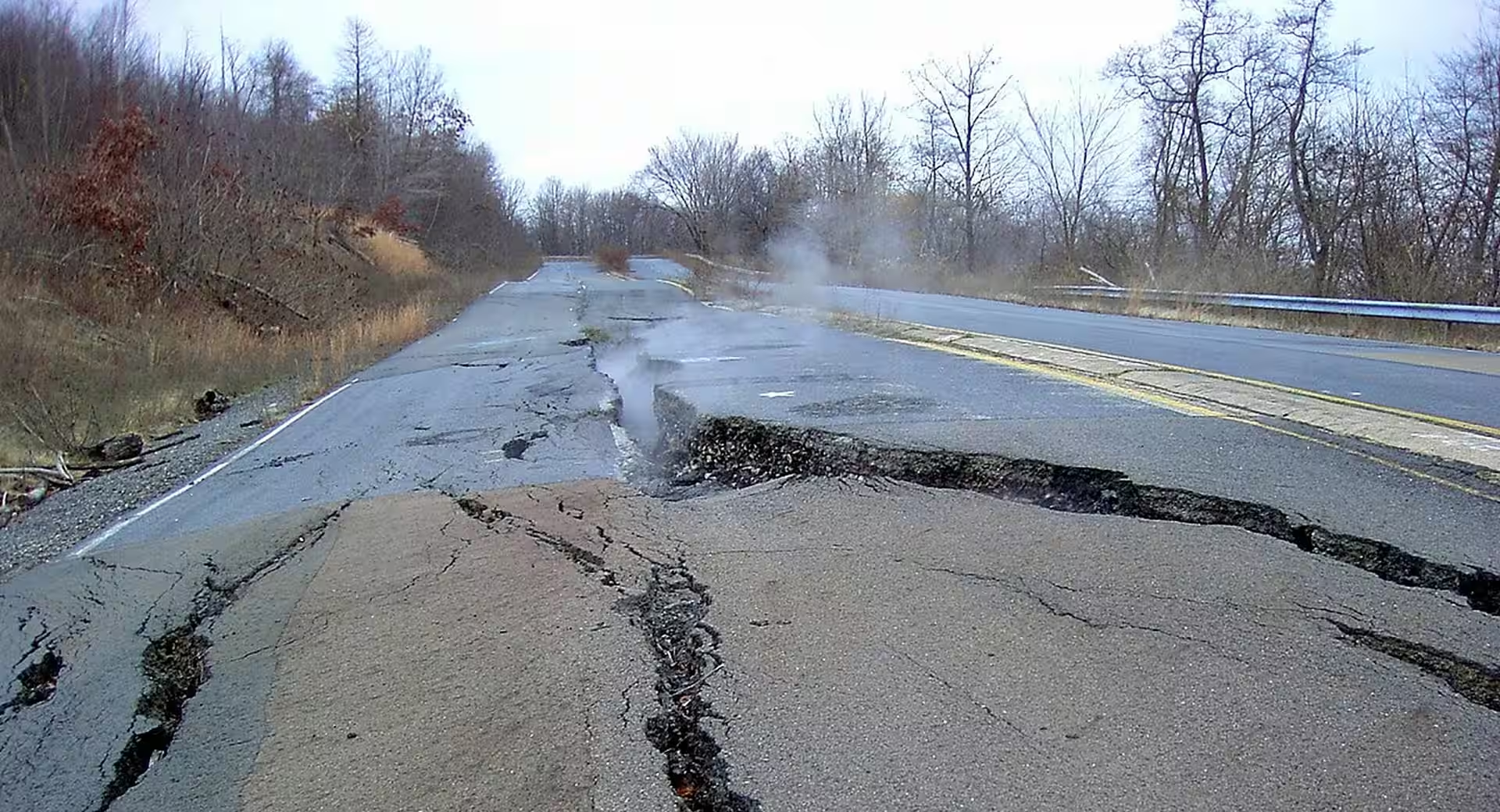
Beneath the borough of Centralia, Pennsylvania, something has been burning since 1962. Not a fire that anyone is fighting. Not a fire that anyone expects to extinguish. A coal seam fire, burning at depths of up to 300 feet through an estimated 3,700 acres of abandoned mine workings — a fire that geologists estimate could continue for another 250 years.
Centralia Pennsylvania was once a town of over 1,100 people. Today, five residents remain. The streets are mostly gone. The houses have been demolished or swallowed by returning forest. The ZIP code was discontinued in 2002. Somewhere below the ground, the fire keeps burning — and will keep burning long after everyone alive today is gone.
A town built on coal
To understand what happened to Centralia, you have to understand what it was built on.
Centralia sits in the anthracite coal region of Columbia County, in the mountains of central Pennsylvania. Coal mining began there in the mid-nineteenth century, and the town grew around it — churches, a post office, hotels, a population that peaked at around 2,700 in the early twentieth century. Beneath the streets ran a labyrinth of abandoned mine shafts and tunnels, dug out over decades and then left empty, the coal extracted and the voids remaining.
This is what made Centralia’s catastrophe possible. Not the fire itself — fires start. What made it catastrophic was the infrastructure that allowed it to spread invisibly, underground, for years before anyone grasped the scale of what was happening.
How a dump fire became a catastrophe
On May 27, 1962, firefighters in Centralia lit a controlled burn in an abandoned strip-mining pit that had been used as a garbage dump — a common waste-management practice at the time. The fire was supposed to be extinguished afterward. It wasn’t, or at least not fully. Through an unsealed opening in the pit, the fire reached the coal seam below, and from there entered the network of abandoned mine tunnels beneath the town.
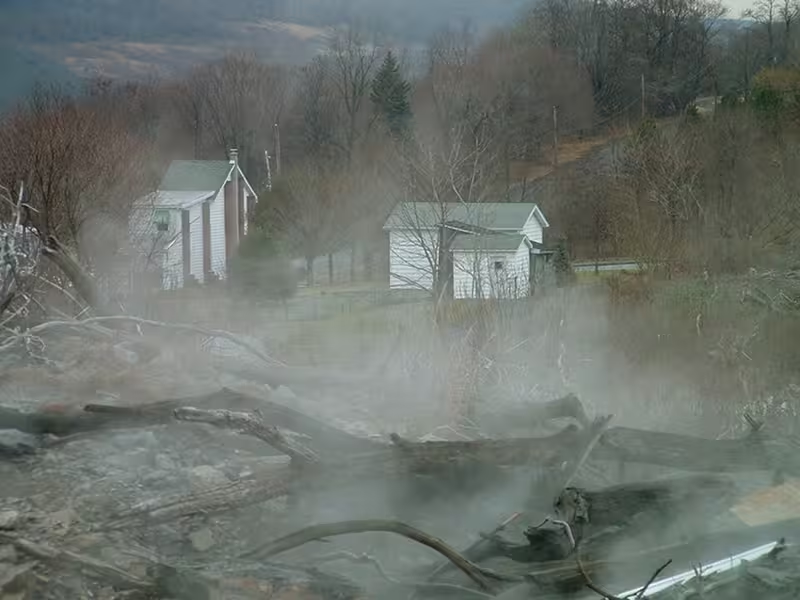
What followed was not an explosion or a visible disaster. It was something quieter and in many ways more disturbing: a slow, invisible spread. Residents noticed strange things — patches of unusually warm ground, vegetation dying in odd patterns, a sulfurous smell rising from basement floors. Carbon monoxide detectors alarmed without apparent cause. For years, the Centralia mine fire burned beneath the town while officials debated its extent, its direction, and what to do about it.
Attempts to extinguish or contain the fire failed repeatedly. The mine system was too extensive, too poorly mapped, and the coal too abundant. By the late 1970s, the situation had become undeniable.
Why the fire cannot be stopped
Underground coal fires are among the most persistent phenomena on Earth — and understanding why explains why Centralia’s fate was effectively sealed from the beginning.
Unlike surface fires, coal seam fires burn as smoldering combustion: slow, oxygen-limited, and extraordinarily heat-retentive. The surrounding rock acts as insulation, keeping temperatures high enough to sustain combustion even with minimal airflow. Rain and snow — which extinguish almost every other kind of fire — cannot reach the coal seam, and even when water is deliberately pumped in, it can make things worse: as dry coal reabsorbs water, the heat of absorption can reignite an apparently quenched fire once the area dries.
Centralia is not unique. There are hundreds of underground coal fires burning around the world at any given time — across China, India, Indonesia, Germany, and throughout the coal regions of the United States, where the Office of Surface Mining Reclamation counts dozens of active underground mine fires in Pennsylvania alone. Globally, coal seam fires are estimated to produce approximately three percent of the world’s annual CO₂ emissions, and release around 40 tons of mercury into the atmosphere each year. They are one of the least discussed environmental problems on Earth, in part because they are invisible.
Extinguishing Centralia entirely would require excavating and removing all the coal in the fire’s path — an engineering project estimated to cost hundreds of millions of dollars, for a town that no longer exists. The decision, made implicitly decades ago, is to let it burn.
The moment everything changed
On February 14, 1981, twelve-year-old Todd Domboski was walking across his grandmother’s backyard when the ground gave way beneath him. He fell into a sinkhole — a void opened by the burning mine below — approximately 150 feet deep, filled with carbon monoxide and steam. His fourteen-year-old cousin Eric Wolfgang grabbed his hand and pulled him out.
Domboski survived. The incident made national news and transformed the political conversation around Centralia. This was no longer an abstract geological problem. A child had nearly fallen into a burning hole in his grandmother’s garden.
In 1984, the United States Congress allocated $42 million — approximately $130 million in today’s money — for the voluntary relocation of Centralia’s residents. Most accepted and left. Houses were purchased and demolished. Streets were closed. By 1992, the Commonwealth of Pennsylvania had claimed all remaining real estate under eminent domain and condemned the borough.
The people who stayed
Not everyone left willingly — and their reasons were more complicated than simple stubbornness.
A group of holdouts refused to accept relocation, challenging the condemnation order in court and winning the right to remain in their homes for the rest of their natural lives. Some cited simple attachment to the only place they had ever known. Others made a more pointed argument: that the fire posed little real danger to their particular corner of town, and that the government’s urgency to remove them had less to do with safety than with what lay beneath.
Centralia, uniquely among Pennsylvania boroughs, owned the mineral rights to the coal under the town. Under state law, once the borough ceased to exist, those rights would revert to the Commonwealth — which could then sell them to mining companies. Several residents accused the government of engineering the town’s dissolution to access coal reserves that some estimated to be worth hundreds of millions of dollars. The accusation was never proven — journalist David DeKok, who spent years researching the story, concluded he found no hard evidence of conspiracy — but it was never fully dispelled either, and it became part of the legal and moral texture of Centralia’s final years.
John Lokitis Jr. was among the last to go. Born in Centralia, he spent his final years in the ghost town tending to its cemeteries, mowing vacant lots, and painting benches in a place that had almost no one left to sit on them. When the Commonwealth finally issued his eviction order in 2009, he nailed a sign to the front porch of his grandfather’s house before leaving: Requiescat in pace. Sorry Pop. The house was demolished the following year.
The graffiti highway
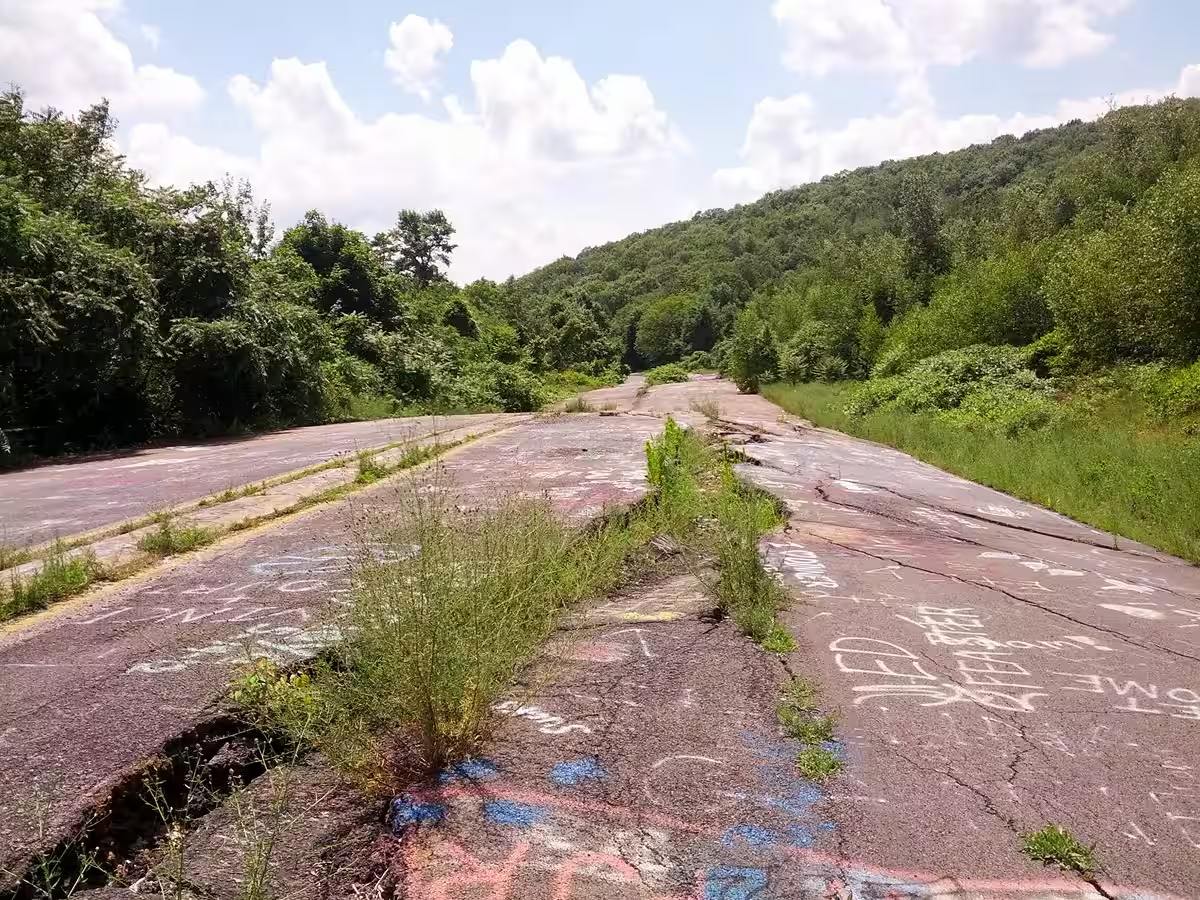
Old Route 61 — the main road through Centralia, closed in the 1990s after the ground beneath it buckled and cracked from the heat below — became, over the following decades, something unexpected: a destination.
Visitors began arriving to walk the half-mile stretch of abandoned highway, its surface heaved and fractured by the fire, and to leave their mark in paint and spray can. The graffiti highway became a strange monument — part memorial, part canvas, part pilgrimage site for people drawn to places where something has gone irreversibly wrong. In winter, snow melts in patches above where the fire burns closest to the surface. Steam rises from fissures in the cracked asphalt. The effect is exactly as unsettling as it sounds.
In April 2020, the property owner covered the graffiti highway with gravel specifically to deter visitors and discourage trespassing. The road is now largely inaccessible, though the rest of Centralia’s former street grid remains walkable.
The Silent Hill connection
The 2006 film Silent Hill, directed by Christophe Gans, is set in a fictional abandoned American town perpetually shrouded in ash and fog, built over a fire that never went out. Gans has acknowledged that Centralia was a direct inspiration — the film’s working title during early production was simply Centralia. Screenwriter Roger Avary researched the town extensively while writing the screenplay.
It is worth being precise: the original Silent Hill video game series, developed by Konami in Japan beginning in 1999, was not based on Centralia. The games drew on different influences. But when the games were adapted for film, Gans and Avary shaped its visual language around the real Pennsylvania town — the steaming ground, the empty streets, the sense of a place where something fundamental has gone wrong beneath the surface, permanently and without remedy.
The result is one of those odd cultural loops where fiction and reality reinforce each other. Visitors come to Centralia because of Silent Hill. Others visit Centralia and then watch Silent Hill differently. The town has acquired a kind of fame it never chose — built on disaster and its artistic echo.
Can you visit Centralia today?
Centralia is not formally closed to the public, and the former street grid can be walked. The five remaining residents live there legally, and the hilltop cemetery is open and maintained.
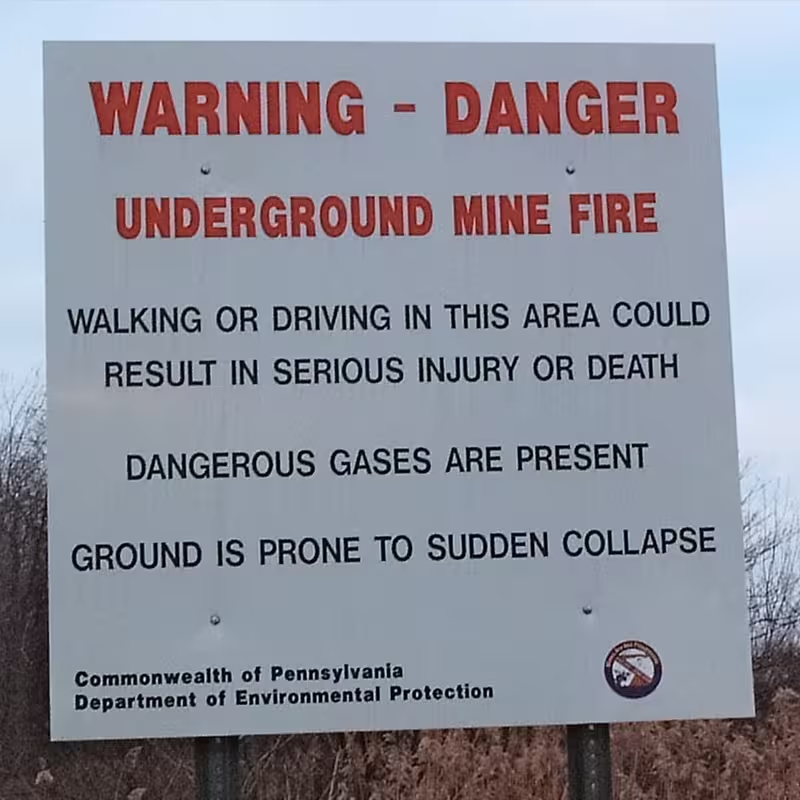
The graffiti highway on Old Route 61 is on private property, and trespassing is illegal. The risks elsewhere are real but manageable if approached carefully: ground temperatures in active areas can be dangerously high, sinkholes can open without warning, and carbon monoxide is present in some locations at hazardous concentrations. The Pennsylvania DEP does not recommend exploring the area, and these hazards are not theoretical.
If you go — and many people do — stay on public roads, do not approach steaming ground vents, and do not go alone.
What Centralia tells us
There is something philosophically strange about Centralia that goes beyond the spectacle of a burning ghost town.
The fire cannot be stopped with any technology that anyone is willing to pay for. The decision, made implicitly, is to wait. To let 250 years pass. To accept that a mistake made in an afternoon in 1962 will outlast everyone alive today, their children, and very possibly their grandchildren.
Centralia, Pennsylvania is a reminder that some consequences are longer than human attention spans — and that the distance between a controlled burn and an uncontrollable one can be a single unsealed hole in the ground.
The town is gone. The fire continues. And somewhere beneath the empty lots and the returning forest and the memory of John Lokitis painting benches for no one, the coal that took millions of years to form is still, quietly, becoming ash.
The Centralia mine fire is monitored by the Pennsylvania Department of Environmental Protection. Current fire status and boundary maps are available at pa.gov.
Sources : Wikipedia — Centralia mine fire · Wikipedia — Centralia, Pennsylvania · History.com · All That’s Interesting · Dangerous Minds — Silent Hill · CentraliaPA.org — John Lokitis · CentraliaPA.org — Conspiracy theory · Global Forest Watch — Coal seam fires · Pennsylvania DEP